Normality satisfies intermediate subgroup condition
This article gives the statement, and possibly proof, of a basic fact in group theory.
View a complete list of basic facts in group theory
VIEW FACTS USING THIS: directly | directly or indirectly, upto two steps | directly or indirectly, upto three steps|
VIEW: Survey articles about this
This article gives the statement, and possibly proof, of a subgroup property (i.e., normal subgroup) satisfying a subgroup metaproperty (i.e., intermediate subgroup condition)
View all subgroup metaproperty satisfactions | View all subgroup metaproperty dissatisfactions |Get help on looking up metaproperty (dis)satisfactions for subgroup properties
Get more facts about normal subgroup |Get facts that use property satisfaction of normal subgroup | Get facts that use property satisfaction of normal subgroup|Get more facts about intermediate subgroup condition
Statement
Verbal statement
If a subgroup is normal in the whole group, it is also normal in every intermediate subgroup of the group containing it.
Statement with symbols
Let be groups such that (viz., is normal in ). Then, is normal in .


Property-theoretic statement
The subgroup property of being normal satisfies the Intermediate subgroup condition (?).
Related facts
Related metaproperties satisfied by normality
Here are some related metaproperties that normality satisfies:
| Metaproperty name | Relation | Proof of satisfaction | Full statement |
|---|---|---|---|
| Transfer condition | Stronger than intermediate subgroup condition | Normality satisfies transfer condition | If is normal in and is any subgroup, then is normal in |
| Inverse image condition | Normality satisfies inverse image condition | If is a homomorphism and is normal in , is normal in | |
| Image condition | Injective maps replaced by surjective maps | Normality satisfies image condition | If is surjective and is normal in , is normal in |
| Upper join-closed subgroup property | Normality is upper join-closed | If and are all subgroups of in which is normal, is normal in the join of the s |


Related isomorphism theorems
- Fourth isomorphism theorem (also called the lattice isomorphism theorem or correspondence theorem): This states that if is normal in , the quotient map establishes a bijection between subgroups of containing (which is also a normal subgroup in each such subgroup) and subgroups of .
- Third isomorphism theorem: This states that if and both are normal in , then is normal in , is normal in , and .


General conditions to ensure intermediate subgroup condition
- Left-inner implies intermediate subgroup condition
- Left-extensibility-stable implies intermediate subgroup condition
Here are some other properties that satisfy the intermediate subgroup condition:
| Property | Meaning | Proof that it satisfies intermediate subgroup condition | Relation with normality (in meaning and proof) |
|---|---|---|---|
| Central factor | every inner automorphism of whole group restricts to inner automorphism of subgroup | Central factor satisfies intermediate subgroup condition | both are examples of left-inner implies intermediate subgroup condition |
| Direct factor | factor in an internal direct product | Direct factor satisfies intermediate subgroup condition | |
| Subnormal subgroup | finite chain from subgroup to group, each normal in next | Subnormality satisfies intermediate subgroup condition | This actually follows from the stronger fact that normality satisfies transfer condition and transfer condition is composition-closed |
Here are some that don't:
| Property | Meaning | Proof that it dissatisfies intermediate subgroup condition | Relation with normality (in meaning and proof) | |
|---|---|---|---|---|
| Characteristic subgroup | invariant under all automorphisms | Characteristicity does not satisfy intermediate subgroup condition | The proof fails because automorphisms cannot always be extended to bigger groups (see extensible automorphisms problem) | |
| Full invariance does not satisfy intermediate subgroup condition | invariant under all endomorphisms | Full invariance does not satisfy intermediate subgroup condition | The proof fails because endomorphisms cannot always be extended to bigger groups | ]
Analogues in other algebraic structures
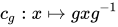
ProofHands-on proofGiven: such that To prove: : for any , . Proof: Pick any . Since , . Further, since is normal in and , . Proof in terms of inner automorphismsThis proof method generalizes to the following results: I-automorphism-invariance satisfies intermediate subalgebra condition over arbitrary varieties of algebras, left-inner implies intermediate subgroup condition, and left-extensibility-stable implies intermediate subgroup condition The key idea here is that since inner automorphisms can be expressed by a formula that is guaranteed to yield an automorphism, any inner automorphism of a smaller subgroup extends to an inner automorphism of a bigger subgroup. Given: , such that is invariant under all inner automorphisms of . To prove: is invariant under all inner automorphisms of . Proof: Suppose is an inner automorphism of . Our goal is to show that .
Proof in terms of idealsThis proof method generalizes to the following results: ideal property satisfies intermediate subalgebra condition over arbitrary varieties of algebras with zero. The key idea here is to view the variety of groups as a variety with zero, i.e., a variety of algebras with a distinguished constant operation -- in this case, the identity element. The ideals in this variety are defined as follows: a subset of a group is an ideal if for any expression with the property that whenever all the are zero, the expression simplifies to zero, it is also true that whenever all the are in and the s are in , the expression yields a value in . It turns out that the ideals in the variety of groups are precisely the same as the normal subgroups (this is a consequence of the proof that the variety of groups is ideal-determined). We thus give the proof in terms of ideals in the variety of groups, assuming the equivalence. Given: A group , an ideal of , a subgroup of containing . To prove: is an ideal of . In other words, for any formula that simplies to the identity element whenever the s are the identity element, we should have that the expression simplifies to a value inside whenever the are in and the are in . Proof: Notice that since the are in , they are also in . Since we know that is an ideal in , we know by the property of that . This completes the proof. Proof in terms of kernel of homomorphismGiven: A group , a subgroup of that is the kernel of a homomorphism . A subgroup of containing . To prove: is the kernel of a homomorphism originating from . Proof: Let be the inclusion map, and . In other words, is the restriction of to . Then, is a homomorphism of groups (because it is a composite of two homomorphisms), and the kernel of is , completing the proof. |