Fourth isomorphism theorem
This article gives the statement, and possibly proof, of a basic fact in group theory.
View a complete list of basic facts in group theory
VIEW FACTS USING THIS: directly | directly or indirectly, upto two steps | directly or indirectly, upto three steps|
VIEW: Survey articles about this
This article is about an isomorphism theorem in group theory.
View a complete list of isomorphism theorems| Read a survey article about the isomorphism theorems
Name
This result is termed the lattice isomorphism theorem, the fourth isomorphism theorem, and the correspondence theorem.
Statement
Statement with symbols
Let be a group and let be a Normal subgroup (?) of . Then, we have a bijection:


Set of subgroups of containing Set of subgroups of


If is the quotient map, then this bijection is given by:


in the forward direction, and:

in the reverse direction. Moreover:
- Under the bijection, normality is preserved. In other words, a subgroup containing is normal if and only if its image under is normal.
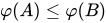
- The bijection is an isomorphism between the lattice of subgroups of containing , and the lattice of subgroups of . In other words, the bijection preserves partial order: if and only if . It also preserves intersections and joins.
- The bijection preserves index. If are subgroups of containing , with , then .



![{\displaystyle [B:A]=[\varphi (B):\varphi (A)]}](https://wikimedia.org/api/rest_v1/media/math/render/svg/a26b61a079fdc6f7846ac10c35a3244c11a57cd9)
References
Textbook references
- Abstract Algebra by David S. Dummit and Richard M. Foote, 10-digit ISBN 0471433349, 13-digit ISBN 978-0471433347, More info, Page 99, Theorem 20, Section 3.3 (few steps of proof given, but full proof not provided)
- Algebra by Michael Artin, ISBN 0130047635, 13-digit ISBN 978-0130047632, More info, Page 75, Exercise 8, Section 7 (Restriction of a homomorphism to a subgroup) (starred problem, termed Correspondence Problem)