Normality is quotient-transitive
This article gives the statement, and possibly proof, of a subgroup property satisfying a subgroup metaproperty
View all subgroup metaproperty satisfactions | View all subgroup metaproperty dissatisfactions |Get help on looking up metaproperty (dis)satisfactions for subgroup properties
|
Property "Page" (as page type) with input value "{{{property}}}" contains invalid characters or is incomplete and therefore can cause unexpected results during a query or annotation process.Property "Page" (as page type) with input value "{{{metaproperty}}}" contains invalid characters or is incomplete and therefore can cause unexpected results during a query or annotation process.
Statement
Symbolic statement
Suppose is a normal subgroup of and is a subgroup of containing , such that is normal in . Then is also normal in .


Related facts
- Third isomorphism theorem is a statement describing the isomorphism types of the various quotient groups.
Generalization and other particular cases
A general version is:
Quotient-balanced implies quotient-transitive
Other particular cases are:
- Characteristicity is quotient-transitive
- Strict characteristicity is quotient-transitive
- Full invariance is quotient-transitive
Related facts about normality
- Normality is strongly join-closed
- Normality is not transitive
- Normality satisfies image condition
- Normality satisfies inverse image condition
Proof
Hands-on proof
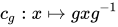
Pick . Then the map is an inner automorphism of , hence sends to itself and induces an automorphism of . More importantly, the induced automorphism on is also an inner automorphism, by the image of under the quotient map . Since is normal in , the induced map on preserves the subgroup . Hence sends to .