Linear representation theory of dihedral groups
This article gives specific information, namely, linear representation theory, about a family of groups, namely: dihedral group.
View linear representation theory of group families | View other specific information about dihedral group
This article discusses the irreducible representations of finite dihedral groups.
Note first that all dihedral groups are ambivalent groups -- every element is conjugate to its inverse. Thus, all the irreducible representations of a dihedral group over the complex numbers can be realized over the real numbers.
Summary
We consider here the dihedral group of degree and order . So, for instance, for , the corresponding group is dihedral group:D8.


| Item | Value |
|---|---|
| degrees of irreducible representations over a splitting field | Case odd: 1 (2 times), 2 ( times) Case even: 1 (4 times), 2 ( times) maximum: 2 (if ), lcm: 2 (if ), number: for odd, for even, sum of squares: |
| Schur index values of irreducible representations over a splitting field | 1 (all of them) |
| condition for a field to be a splitting field | First, the field should have characteristic not equal to 2 or any prime divisor of . Also, take the cyclotomic polynomial . Let be a root of the polynomial. Then, the field should contain the element , i.e., the minimal polynomial for should split completely. |
| smallest ring of realization (characteristic zero) | |
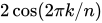
| smallest field of realization (characteristic zero) | . Note that a degree two extension of this gives the cyclotomic extension of for primitive roots of unity. The given field can be thought of as the intersection of the cyclotomic extension and the real numbers. |
| smallest size splitting field | unclear. Definitely, for a field of odd size , dividing is sufficient, but not necessary. |
| degrees of irreducible representations over rational numbers | PLACEHOLDER FOR INFORMATION TO BE FILLED IN: [SHOW MORE] |


![{\displaystyle \mathbb {Z} [2\cos(2\pi /n)]}](https://wikimedia.org/api/rest_v1/media/math/render/svg/48a8427d4dfaaec41b6812179038a2ab4e40e7d9)


YOU MAY ALSO BE INTERESTED IN: linear representation theory of generalized dihedral groups, linear representation theory of dicyclic groups
Particular cases
Note that that cases and are atypical.


| Degree | Order | odd or even? | Dihedral group | Degrees of irreducible representations | Number of irreducible representations ( if odd, if even) | Smallest splitting field (characteristic zero) | Linear representation theory page |
|---|---|---|---|---|---|---|---|
| 1 | 2 | odd | cyclic group:Z2 | 1,1 | 2 | linear representation theory of cyclic group:Z2 | |
| 2 | 4 | even | Klein four-group | 1,1,1,1 | 4 | linear representation theory of Klein four-group | |
| 3 | 6 | odd | symmetric group:S3 | 1,1,2 | 3 | linear representation theory of symmetric group:S3 | |
| 4 | 8 | even | dihedral group:D8 | 1,1,1,1,2 | 5 | linear representation theory of dihedral group:D8 | |
| 5 | 10 | odd | dihedral group:D10 | 1,1,2,2 | 4 | linear representation theory of dihedral group:D10 | |
| 6 | 12 | even | dihedral group:D12 | 1,1,1,1,2,2 | 6 | linear representation theory of dihedral group:D12 | |
| 7 | 14 | odd | dihedral group:D14 | 1,1,2,2,2 | 5 | linear representation theory of dihedral group:D14 | |
| 8 | 16 | even | dihedral group:D16 | 1,1,1,1,2,2,2 | 7 | linear representation theory of dihedral group:D16 |


The linear representation theory of dihedral groups of odd degree
Consider the dihedral group , where is odd:
.

The group has a total of conjugacy classes: the identity element, other conjugacy classes in , and the conjugacy class of . Thus, there are irreducible representations. We discuss these representations.


The two one-dimensional representations
The derived subgroup is , and hence the abelianization of the group is cyclic of order two. Thus, there are two one-dimensional representations:
- The trivial representation, sending all elements to the matrix .
- The representation sending all elements in to and all elements outside to .


The two-dimensional representations
There are irreducible two-dimensional representations. The representation is given in the following equivalent forms:

| Group element | Matrix as real orthogonal | Matrix as complex unitary | Matrix as real, non-orthogonal, in | Character (trace of any of the matrices) | Minimal polynomial |
|---|---|---|---|---|---|
| ? | |||||
| ? |




The linear representation theory of dihedral groups of even degree
Consider the dihedral group , where is even:
.
This group has conjugacy classes: the identity element, the element , other conjugacy classes in , and two conjugacy classes outside , with representatives and .


The four one-dimensional representations
The commutator subgroup is , which has index four, and the quotient group (the [[abelianization]) is a Klein four-group. There are thus four one-dimensional representations:

- The trivial representation, sending all elements to the matrix .
- The representation sending all elements in to and all elements outside to .
- The representation sending all elements in to and to .
- The representation sending all elements in to and to .


The two-dimensional representations
There are irreducible two-dimensional representations. All of these can be realized over . The representations can be described in a number of different ways. The description of the representation is given below:
| Group element | Matrix as real orthogonal | Matrix as complex unitary | Matrix as real, non-orthogonal, in | Character (trace of any of the matrices) | Minimal polynomial |
|---|---|---|---|---|---|
| ? | |||||
| ? |
Note that for the representations for and are equivalent, hence we get distinct representations only for . (The representations for and are not irreducible and they break up into one-dimensional representations already discussed).


Degrees of irreducible representations
FACTS TO CHECK AGAINST FOR DEGREES OF IRREDUCIBLE REPRESENTATIONS OVER SPLITTING FIELD:
Divisibility facts: degree of irreducible representation divides group order | degree of irreducible representation divides index of abelian normal subgroup
Size bounds: order of inner automorphism group bounds square of degree of irreducible representation| degree of irreducible representation is bounded by index of abelian subgroup| maximum degree of irreducible representation of group is less than or equal to product of maximum degree of irreducible representation of subgroup and index of subgroup
Cumulative facts: sum of squares of degrees of irreducible representations equals order of group | number of irreducible representations equals number of conjugacy classes | number of one-dimensional representations equals order of abelianization
The summary (based on the detailed description above):
| Parity of | Number of degree 1 representations | Number of degree 2 representations | Total number |
|---|---|---|---|
| odd | 2 | ||
| even | 4 |
Realizability information
Quick summary for realization of characters
| Case | Character ring (ring generated by characters) | Degree of field extension of containing character ring |
|---|---|---|
| odd | ||
| , odd, | ||
| , odd or even |
![{\displaystyle \mathbb {Z} [2\cos(2\pi /n)]=\mathbb {Z} [2\cos(\pi /n)]}](https://wikimedia.org/api/rest_v1/media/math/render/svg/bcc3bafe860bc85d822ae492afa2295a099ba586)


![{\displaystyle \mathbb {Z} [2\cos(2\pi /n)]=\mathbb {Z} [2\cos(2\pi /m)]}](https://wikimedia.org/api/rest_v1/media/math/render/svg/8625993c019c2dc908239bebf090841ff231b9ae)


![{\displaystyle \mathbb {Z} [2\cos(2\pi /n)]=\mathbb {Z} [2\sin(2\pi /n)]}](https://wikimedia.org/api/rest_v1/media/math/render/svg/502d204c89ec303b2d71c97f1c23e8ab255e581f)
Schur index and realization of representations
It turns out that for all irreducible representations of the dihedral group, the Schur index equals one. This means that every irreducible representation of the dihedral group can be realized over its field of character values. In particular, all the irreducible representations of the dihedral group can be realized over the field .
Quick summary for orthogonal representations
| Case | Smallest ring over which all irreducible representations written as orthogonal representations are realized | Degree of field extension of containing it |
|---|---|---|
| odd | ||
| , odd | ||
| , odd or even |
![{\displaystyle \mathbb {Z} [\cos(2\pi /n),\sin(2\pi /n)]}](https://wikimedia.org/api/rest_v1/media/math/render/svg/125db6926b1be85ae1b35cde55bcab52ba0cc32a)


![{\displaystyle \mathbb {Z} [\cos(2\pi /n)]}](https://wikimedia.org/api/rest_v1/media/math/render/svg/2dabc572bb2a56cc16d9821aa40bd8b186c247a5)
Smaller splitting fields: some specific examples
The symmetric group of degree three, which is also the dihedral group of order six (and degree three) is an example of a group for which the splitting field is , which is equal to itself. Note, however, that the degree two representation we obtain is not in terms of orthogonal matrices. Further information: Linear representation theory of symmetric group:S3

The Klein four-group (which is a dihedral group of order four and degree two) and dihedral group:D8 (which has order eight and degree four) are the only examples where the representations described above are naturally over .
Representations in prime characteristic
If is a prime number not dividing the order of the dihedral group, we can discuss the linear representation theory in characteristic . The representations remain the same; however, we need to replace with the element , where is a primitive root of unity. All the irreducible characters take values in the field , while all the irreducible representations are realized over the field .


The groups (Klein four-group, order four, degree two), (also symmetric group of degree three, order six, degree three), and (dihedral group of order eight, degree four) have representations that can be realized over a prime field of any characteristic relatively prime to their respective orders.


Orthogonality relations and numerical checks
- The degrees of irreducible representations are all or . This confirms the fact that degree of irreducible representation divides index of abelian normal subgroup. In this case, the abelian normal subgroup is the cyclic subgroup and it is a subgroup of index two.
- The number of irreducible representations is for odd and for even , which is equal to the number of conjugacy classes in either case.
- The number of one-dimensional representations is for odd and for even , which is equal to the order of the abelianization in either case.
- For odd , the sum of squares of degrees of irreducible representations is , which is equal to the order of the group. For even , the sum of squares of degrees of irreducible reprensetations is , which is equal to the order of the group. This confirms the fact that sum of squares of degrees of irreducible representations equals order of group.
- The character table satisfies the orthogonality relations: in particular, the row orthogonality theorem and the column orthogonality theorem.


Action of automorphism group
The special case
For , the automorphism group permutes the three nontrivial one-dimensional representations. This anomalous behavior is explained by the fact that in the case, and are related by an automorphism.
The general case of odd
We have the following:
- Both one-dimensional representations are preserved by the action of the automorphism group.
- For the two-dimensional representations, there are equivalence classes under the action of the automorphism group, where is the number of divisors of . Specifically, for every divisor of , there is an equivalence class of irreducible two-dimensional representations of size (where is the Euler totient function) comprising the irreducible representation for all with .


The general case of even
We have the following for :

- The trivial one-dimensional representation as well as the one-dimensional representation with kernel are preserved by all automorphisms.
- The other two one-dimensional representations are interchanged by an outer automorphism.
- For the two-dimensional representations, there are equivalence classes under the action of the automorphism group, where is the number of divisors of . Specifically, for every divisor of , there is an equivalence class of irreducible two-dimensional representations of size (where is the Euler totient function) comprising the irreducible representation for all with .


Relation with representations of subgroups
Induced representations from the cyclic maximal subgroup
All the two-dimensional irreducible representations are obtained as induced representations from one-dimensional complex representations of the cyclic subgroup . More specifically:
- The representation induces the corresponding two-dimensional representation for .
- The representations for and , though inequivalent as one-dimensional representations, induce equivalent two-dimensional representations.
- For odd, the only for which we get a reducible two-dimensional representation is . Thus, there are irreducible representations coming from the values , and there are two reducible representations coming from the decomposition of the induced representation from .
- For even, and are the only cases where we get a reducible two-dimensional representation. Thus, there are irreducible representations coming from the other values, and there are four reducible representations coming from the decomposition of the induced representations for and .


