Classification of nilpotent Lie rings of prime-cube order
Statement
Let be a prime number. There are, up to isomorphism, five possibilities for a nilpotent Lie ring of order . Three of them are abelian and two are non-abelian.


For odd primes, we can use the Baer correspondence (a special case of the Lazard correspondence) to achieve a one-to-one correspondence between the nilpotent Lie rings of order and the groups of order .
For the prime , although the number of nilpotent Lie rings equals the number of groups, we cannot use the Baer correspondence. More specifically, there is no natural way of matching the two non-abelian groups of order and the two non-abelian nilpotent Lie rings of order .

The three abelian Lie rings
The three abelian Lie rings are the Lie rings with trivial Lie bracket; these thus correspond to the abelian groups of order . They are classified by the partitions of 3:
| Partition of 3 | Corresponding additive group of Lie ring |
|---|---|
| 3 | cyclic group of prime-cube order, denoted or , or |
| 2 + 1 | direct product of cyclic group of prime-square order and cyclic group of prime order, denoted or |
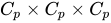
| 1 + 1 + 1 | elementary abelian group of prime-cube order, denoted , or , or |



The two non-abelian nilpotent Lie rings
The two non-abelian nilpotent Lie rings are given as follows:
| Lie ring name | Presentation | Nilpotency class | Additive group | Corresponding group under Baer correspondence in case of odd prime |
|---|---|---|---|---|
| semidirect product of cyclic Lie ring of prime-square order and cyclic Lie ring of prime order | 2 | direct product of cyclic group of prime-square order and cyclic group of prime order | semidirect product of cyclic group of prime-square order and cyclic group of prime order | |
| upper-triangular nilpotent matrix Lie ring:u(3,p) | 2 | elementary abelian group of prime-cube order | prime-cube order group:U(3,p); see Baer correspondence between u(3,p) and U(3,p) |
![{\displaystyle \langle a,b\mid p^{2}a=pb=0,[a,b]=a\rangle }](https://wikimedia.org/api/rest_v1/media/math/render/svg/9ef05b223e528f1efaf3951e7660f4277dfa35dc)
![{\displaystyle \langle a,b,c\mid pa=pb=pc=0,[a,c]=b,[a,b]=[b,c]=0\rangle }](https://wikimedia.org/api/rest_v1/media/math/render/svg/b09214fe96c3f367b871ed8ea79c4e236b8177d2)
Proof
First part of proof: crude description of center and quotient by center
Given: A prime number , a nilpotent Lie ring of order .

To prove: Either is abelian, or is cyclic of order and the quotient is an abelian Lie ring of order whose additive group is elementary abelian of order .


Proof: Let be the center of .

Note: Some proof details need to be clarified, but the outline is complete and good enough for people thorough with group theory.
| Step no. | Assertion/construction | Facts used | Given data used | Previous steps used | Explanation |
|---|---|---|---|---|---|
| 1 | is nontrivial | is nilpotent and nontrivial | Given direct | ||
| 2 | The order of cannot be | PLACEHOLDER FOR INFORMATION TO BE FILLED IN: [SHOW MORE] | has order | ||
| 3 | The order of is either or | Steps (1), (2) | |||
| 4 | If has order , then is cyclic of order and the quotient is elementary abelian of order . | ||||
| 5 | If has order , is abelian | ||||
| 6 | We get the desired result. | Steps (4), (5) | Step-combination. |


Second part of proof: classifying the abelian Lie rings
Third part of proof: classifying the non-abelian nilpotent Lie rings
Since we already know and , we need to specify two things:

- The alternating bilinear map given by the Lie bracket: There is only one option for this (up to isomorphism) because is isomorphic to , and, up to conjugacy, there is a unique isomorphism.
- The nature of the additive group extension of on top of : There are two possibilities for this: elementary abelian group of prime-square order (corresponding to the trivial or split extension)and direct product of cyclic group of prime-square order and cyclic group of prime order (corresponding to the nontrivial extensions).


Working out the corresponding Lie ring structures, we get upper-triangular nilpotent matrix Lie ring:u(3,p) (corresponding to the trivial extension) and semidirect product of cyclic Lie ring of prime-square order and cyclic Lie ring of prime order (corresponding to the nontrivial extension).