Classification of groups of prime-cube order: Difference between revisions
No edit summary |
(→Proof) |
||
| Line 53: | Line 53: | ||
| 2 ||The order of <math>Z</math> cannot be <math>p^2</math> || Facts (2), (3), (4), (5) || <math>P</math> has order <math>p^3</math> || || <toggledisplay>If <math>Z</math> has order <math>p^2</math>, then <math>P/Z</math> (which exists by fact (2)) has order <math>p</math> (by fact (4)) hence must be cyclic (by fact (5)). Then, by fact (3), <math>P</math> would be abelian, but this would imply that <math>Z = P</math>, in which case the order of <math>Z</math> would be <math>p^3</math>.</toggledisplay> | | 2 ||The order of <math>Z</math> cannot be <math>p^2</math> || Facts (2), (3), (4), (5) || <math>P</math> has order <math>p^3</math> || || <toggledisplay>If <math>Z</math> has order <math>p^2</math>, then <math>P/Z</math> (which exists by fact (2)) has order <math>p</math> (by fact (4)) hence must be cyclic (by fact (5)). Then, by fact (3), <math>P</math> would be abelian, but this would imply that <math>Z = P</math>, in which case the order of <math>Z</math> would be <math>p^3</math>.</toggledisplay> | ||
|- | |- | ||
| 3 || The order of <math>Z</math> is either <math>p</math> or <math>p^3</math> || Fact (4) || <math>P</math> has order <math>p^3</math> || Steps (1), (2) || By fact (4), the order of <math>Z</math> must divide the order of <math>P</math>. The only possibilities are <math>1,p,p^2,p^3</math>. Step (1) eliminates the possibility of <math>1</math>, and step (3) eliminates the possibility of <math>p^2</math>. This leaves only <math>p</math> or <math>p^3</math>.</toggledisplay> | | 3 || The order of <math>Z</math> is either <math>p</math> or <math>p^3</math> || Fact (4) || <math>P</math> has order <math>p^3</math> || Steps (1), (2) || >toggledisplay>By fact (4), the order of <math>Z</math> must divide the order of <math>P</math>. The only possibilities are <math>1,p,p^2,p^3</math>. Step (1) eliminates the possibility of <math>1</math>, and step (3) eliminates the possibility of <math>p^2</math>. This leaves only <math>p</math> or <math>p^3</math>.</toggledisplay> | ||
|- | |- | ||
| 4 ||If <math>Z</math> has order <math>p</math>, then <math>Z</math> is cyclic of order <math>p</math> and the quotient <math>P/Z</math> is elementary abelian of order <math>p^2</math> || Facts (3), (4), (5), (6) || <math>P</math> has order <math>p^3</math>. || || <toggledisplay>If <math>Z</math> has order <math>p</math>, then by fact (5), <math>Z</math> must be cyclic. By Fact (4), <math>P/Z</math> has order <math>p^2</math>. Further, by fact (3), <math>P/Z</math> cannot be cyclic, because if it were cyclic, then <math>P</math> would be abelian, which would mean that <math>Z = P</math> has order <math>p^3</math>. Thus, <math>P/Z</math> is a ''non-cyclic'' group of order <math>p^2</math>. By fact (6), it must be the elementary abelian group of order <math>p^2</math>.</toggledisplay> | | 4 ||If <math>Z</math> has order <math>p</math>, then <math>Z</math> is cyclic of order <math>p</math> and the quotient <math>P/Z</math> is elementary abelian of order <math>p^2</math> || Facts (3), (4), (5), (6) || <math>P</math> has order <math>p^3</math>. || || <toggledisplay>If <math>Z</math> has order <math>p</math>, then by fact (5), <math>Z</math> must be cyclic. By Fact (4), <math>P/Z</math> has order <math>p^2</math>. Further, by fact (3), <math>P/Z</math> cannot be cyclic, because if it were cyclic, then <math>P</math> would be abelian, which would mean that <math>Z = P</math> has order <math>p^3</math>. Thus, <math>P/Z</math> is a ''non-cyclic'' group of order <math>p^2</math>. By fact (6), it must be the elementary abelian group of order <math>p^2</math>.</toggledisplay> | ||
Revision as of 21:37, 10 April 2011
Statement
Let be a prime number. Then there are, up to isomorphism, five groups of order . These include three abelian groups and two non-abelian groups. The nature of the two non-abelian groups is somewhat different for the case .


For more information on side-by-side comparison of the groups for odd primes, see groups of prime-cube order. For information for the prime 2, see groups of order 8
The three abelian groups
The three abelian groups correspond to the three partitions of 3:
| Partition of 3 | Corresponding abelian group | GAP ID among groups of order |
|---|---|---|
| 3 | cyclic group of prime-cube order, denoted or , or | 1 |
| 2 + 1 | direct product of cyclic group of prime-square order and cyclic group of prime order, denoted or | 2 |
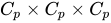
| 1 + 1 + 1 | elementary abelian group of prime-cube order, denoted , or , or | 5 |



The two non-abelian groups
For the case , these are dihedral group:D8 (GAP ID: (8,3)) and quaternion group (GAP ID: (8,4)).
For the case of odd , these are prime-cube order group:U(3,p) (GAP ID: (,3)) and semidirect product of cyclic group of prime-square order and cyclic group of prime order (GAP ID: (,4)).
Facts used
- Prime power order implies not centerless
- Center is normal
- Cyclic over central implies abelian
- Lagrange's theorem
- Equivalence of definitions of group of prime order: This basically states that any group of prime order must be cyclic.
- Classification of groups of prime-square order
- Structure theorem for finitely generated abelian groups
Proof
First part of proof: crude descriptions of center and quotient by center
Given: A prime number , a group of order .

To prove: Either is abelian, or we have: is a cyclic group of order and is an elementary abelian group of order


Proof: Let be the center of .

| Step no. | Assertion/construction | Facts used | Given data used | Previous steps used | Explanation |
|---|---|---|---|---|---|
| 1 | is nontrivial | Fact (1) | has order , specifically, a power of a prime | Fact+Given direct | |
| 2 | The order of cannot be | Facts (2), (3), (4), (5) | has order | [SHOW MORE] | |
| 3 | The order of is either or | Fact (4) | has order | Steps (1), (2) | >toggledisplay>By fact (4), the order of must divide the order of . The only possibilities are . Step (1) eliminates the possibility of , and step (3) eliminates the possibility of . This leaves only or .</toggledisplay> |
| 4 | If has order , then is cyclic of order and the quotient is elementary abelian of order | Facts (3), (4), (5), (6) | has order . | [SHOW MORE] | |
| 5 | If has order , is abelian. | has order . | [SHOW MORE] | ||
| 6 | We get the desired result. | Steps (3), (4), (5) | Step-combination. |


Second part of proof: classifying the abelian groups
This classification follows from fact (7): the abelian groups of order correspond to partitions of 3, as indicated in the original statement of the classification.
Third part of proof: classifying the non-abelian groups
PLACEHOLDER FOR INFORMATION TO BE FILLED IN: [SHOW MORE]