Nilpotent group
Definition
Equivalent definitions in tabular format
| No. | Shorthand | A group is termed nilpotent if ... | A group is termed nilpotent if ... |
|---|---|---|---|
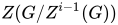
| 1 | upper central series | its upper central series stabilizes after a finite length at the whole group | there is a nonnegative integer such that . Here, we define inductively as follows:
is the inverse image of the center under the natural quotient map from to , and is the trivial subgroup. |
| 2 | lower central series | its lower central series stabilizes after a finite length at the trivial subgroup | there is a nonnegative integer such that is trivial where is repeated times. Here, denotes the commutator of two subgroups. In other words, the lower central series of reaches the identity in finitely many steps. |
| 3 | central series | it possesses a central series | there is a nonnegative integer and a chain of subgroups: such that each is a normal subgroup of and is in the center of . In other words, there exists a central series for of length . |
| 4 | diagonal subnormal in square | the diagonal subgroup is subnormal in the square of the group | the subgroup is subnormal in the square with subnormal depth . |
| 5 | iterated left-normed commutators trivial | there is a finite length such that any iterated left-normed commutator of length more than that becomes trivial | there is a length such that any commutator of the form takes value the identity element, where the are (possibly repeated) elements of . |
| 6 | iterated commutators of any form trivial | there is a finite length such that any iterated commutator (with any kind of parenthesization of terms) of length more than that becomes trivial | there is a length such that any iterated commutator that involves at least commutator operations (so original inputs) takes value the identity element. [SHOW MORE] |
| 7 | iterated left-normed commutators trivial (generating set version) | (pick a generating set for the group) there is a finite length such that any iterated left-normed commutator of elements from that generating set length more than that becomes trivial | pick a generating set for . There is a length such that any commutator of the form takes value the identity element, where the are (possibly repeated) elements of . |
| 8 | iterated commutators of any form trivial (generating set version) | (pick a generating set for the group) there is a finite length such that any iterated commutator (with any kind of parenthesization of terms) of elements from that generating set of length more than that becomes trivial | pick a generating set for . There is a length such that any iterated commutator that involves at least commutator operations (so original inputs) and where the inputs are from , always takes value the identity element. [SHOW MORE] |




![{\displaystyle [[[..[G,G],G],G],...G]}](https://wikimedia.org/api/rest_v1/media/math/render/svg/655c272ee54b42fa209626f358b83fdf46ff9b7c)

![{\displaystyle [,]}](https://wikimedia.org/api/rest_v1/media/math/render/svg/f04349be7aa458edb6f1ab423189a8455c6e21f7)


![{\displaystyle [[\dots [[x_{1},x_{2}],x_{3}],\dots ],x_{c+1}]}](https://wikimedia.org/api/rest_v1/media/math/render/svg/8c235aeba71553e60a97fe1fa56c6152cd1a8168)


![{\displaystyle \![[x_{1},x_{2}],[x_{3},x_{4}]],[[[x_{1},x_{2}],x_{3}],x_{4}]],[x_{1},[x_{2},[x_{3},x_{4}]]]}](https://wikimedia.org/api/rest_v1/media/math/render/svg/949c093fb78f978dad9a3a73ddfaa52773690b21)
![{\displaystyle [[x_{1},[x_{2},x_{3}]],x_{4}],[x_{1},[[x_{2},x_{3}],x_{4}]}](https://wikimedia.org/api/rest_v1/media/math/render/svg/5729b424c3ae087560de5cb16a9a5db8b03e6c36)

The smallest possible for all definitions is termed the nilpotency class (sometimes written nilpotence class) of . We usually say a group is of nilpotency class if its nilpotency class is less than or equal to .
This definition is presented using a tabular format. |View all pages with definitions in tabular format
Equivalence of definitions
Further information: Equivalence of definitions of nilpotent group, equivalence of definitions of nilpotency class
Examples
VIEW: groups satisfying this property | groups dissatisfying this property
VIEW: Related group property satisfactions | Related group property dissatisfactions
- The trivial group is nilpotent, of nilpotency class zero.
- Any abelian group is nilpotent, of nilpotency class one (note that the nilpotency class is exactly one for nontrivial abelian groups).
- Any group of prime power order is nilpotent. Further information: prime power order implies nilpotent. Thus, exploring groups of prime power order is a good starting point for exploring nilpotent groups. See groups of order 8, groups of order 16, groups of order 32, groups of order 27, groups of order 81. See also nilpotency class distribution of finite p-groups.
- The dihedral group of order 8 is the smallest (in terms of order) nilpotent group which is not abelian. It is a group of nilpotency class two.
- The quaternion group is also the smallest (in terms of order) nilpotent group which is not abelian. This also has order eight.
- For , there are in general two non-abelian groups of order , both of which are nilpotent (of class two): semidirect product of cyclic group of prime-square order and cyclic group of prime order and unitriangular matrix group:UT(3,p).


This article is about a standard (though not very rudimentary) definition in group theory. The article text may, however, contain more than just the basic definition
VIEW: Definitions built on this | Facts about this: (facts closely related to Nilpotent group, all facts related to Nilpotent group) |Survey articles about this | Survey articles about definitions built on this
VIEW RELATED: Analogues of this | Variations of this | Opposites of this |
View a complete list of semi-basic definitions on this wiki
This article defines a group property that is pivotal (i.e., important) among existing group properties
View a list of pivotal group properties | View a complete list of group properties [SHOW MORE]
The version of this for finite groups is at: finite nilpotent group
Metaproperties
| Metaproperty name | Satisfied? | Proof | Statement with symbols |
|---|---|---|---|
| pseudovarietal group property | Yes | nilpotency is pseudovarietal | Nilpotency is closed under taking subgroups, quotient groups, and finite direct products. |
| subgroup-closed group property | Yes | nilpotency is subgroup-closed | If is nilpotent, and , then is nilpotent. |
| quotient-closed group property | Yes | nilpotency is quotient-closed | If is nilpotent, and is a normal subgroup, the quotient group is nilpotent. |
| finite direct product-closed group property | Yes | nilpotency is finite direct product-closed | If are all nilpotent groups, the external direct product is also nilpotent. |
| finite normal join-closed group property | Yes | nilpotency is finite normal join-closed | Suppose is a group and are all nilpotent normal subgroups of . Then the join of subgroups (which in this case is also the product of subgroups) is also nilpotent. |
| extension-closed group property | No | nilpotency is not extension-closed | It is possible to have a non-nilpotent group and a normal subgroup such that both and are nilpotent. |
| isoclinism-invariant group property | Yes | isoclinic groups have same nilpotency class | If are isoclinic groups, then is nilpotent if and only if is nilpotent. Further, they have the same nilpotency class (except in the case where one of them is trivial and the other is nontrivial abelian). |





Relation with other properties
This property is a pivotal (important) member of its property space. Its variations, opposites, and other properties related to it and defined using it are often studied
Conjunction with other properties
Conjunctions with other group properties:
| Conjunction | Other component of conjunction | Can it be verified using only the abelianization? | Alternative possibilities for other component of conjunction that give the same result | More about the conjunction |
|---|---|---|---|---|
| finite nilpotent group | finite group | Yes | There are many alternative definitions of finite nilpotent group. The most relevant is that a finite group is nilpotent if and only if it is the internal direct product of its Sylow subgroups. | |
| finitely generated nilpotent group | finitely generated group | Yes | finitely presented group Noetherian group |
The key fact is that the property of being finitely generated can be tested knowing the abelianization. This is because any set of coset representatives for a generating set for the abelianization generate the whole group. |
| periodic nilpotent group | periodic group | Yes | locally finite group | the abelianization suffices because each of the successive quotients for the lower central series are homomorphic images of tensor powers of the abelianization. |
| divisible nilpotent group (or more generally, nilpotent group that is divisible for a set of primes) | divisible group (or more generally, divisible group for a set of primes) | Yes | ||
| rationally powered nilpotent group (or more generally, nilpotent group that is powered over a set of primes) | rationally powered group (or more generally, powered group for a set of primes) | In one direction (if the group is powered, so is the abelianization) but not in the other (it is possible for the abelianization to be powered and for the group to not be powered) | See derived subgroup is quotient-powering-invariant in nilpotent group and also nilpotent group with rationally powered abelianization need not be rationally powered | |
| torsion-free nilpotent group (or more generally, nilpotent group that is torsion-free for a set of primes) | torsion-free group (or more generally, torsion-free group for a set of primes) | No (neither direction) | See nilpotent group with torsion-free abelianization need not be torsion-free nilpotent and torsion-free not implies torsion-free abelianization |
Conjunctions with subgroup properties:
Stronger properties

Weaker properties

Testing
The testing problem
Further information: fixed-class nilpotency testing problem
GAP command
This group property can be tested using built-in functionality of Groups, Algorithms, Programming (GAP).
The GAP command for this group property is:IsNilpotentGroup
The class of all groups with this property can be referred to with the built-in command: NilpotentGroups
View GAP-testable group properties
To test whether a given group is nilpotent or not using GAP, enter:
IsNilpotentGroup (group);
where group is either the definition of a group or a name for a group already defined.
The class of all nilpotent groups is specified as NilpotentGroups.
Formalisms
In terms of ascending series
This group property is obtained by applying the ascending series-finite operator to the subgroup-defining function: center
A group is nilpotent if and only if the ascending series corresponding to the center subgroup-defining function (which is the upper central series) terminates at the whole group in finitely many steps.
In terms of the diagonal-in-square operator
This property is obtained by applying the diagonal-in-square operator to the property: subnormal subgroup
View other properties obtained by applying the diagonal-in-square operator
A group is nilpotent if and only if the diagonal subgroup is subnormal in the group . In fact, the nilpotency class of equals the subnormal depth of the diagonal subgroup.

Study of this notion
Mathematical subject classification
Under the Mathematical subject classification, the study of this notion comes under the class: 20F18
While 20F18 is the subject class used for nilpotent groups, the subject class used for finite nilpotent groups in particular is 20D15.
Closely related is 20F19: Generalizations of nilpotent and solvable groups.
References
Textbook references
| Book | Page number | Chapter and section | Contextual information | View |
|---|---|---|---|---|
| Abstract Algebra by David S. Dummit and Richard M. Foote, 10-digit ISBN 0471433349, 13-digit ISBN 978-0471433347More info | 190 | formal definition, along with lower central series and upper central series | ||
| Groups and representations by Jonathan Lazare Alperin and Rowen B. Bell, ISBN 0387945261More info | 103 | definition in paragraph, along with lower central series and upper central series | ||
| A Course in the Theory of Groups by Derek J. S. Robinson, ISBN 0387944613More info | 122 | formal definition, in terms of central series | ||
| An Introduction to Abstract Algebra by Derek J. S. Robinson, ISBN 3110175444More info | 174 | formal definition, in terms of central series | ||
| Algebra (Graduate Texts in Mathematics) by Thomas W. Hungerford, ISBN 0387905189More info | 100 | definition in paragraph | ||
| Topics in Algebra by I. N. HersteinMore info | 117 | definition introduced based on exercises 13-14, that implicitly define lower central series and upper central series, and precedes exercise 15 |