Group
Definition
QUICK PHRASES: monoid with inverses, set with associative binary operation having identity element and inverses, symmetries of a structure
Understand the definition better at understanding the definition of a group: clarify your doubts
Learn how to apply this definition to verify the group axioms in concrete situations
The textbook definition (with symbols)
A group is a set with a binary operation (termed the multiplication or product and denoted with infix notation -- so the product of is denoted ) such that the following hold:




| Condition name | What it says | Comments |
|---|---|---|
| associativity | For any in , . | Note that are allowed to be equal (i.e., there is no restriction on whether they are equal or not). For instance, all may be equal, all distinct, or two equal and one different. |
| identity element (or neutral element) | There exists an element in such that for all in . Such an is termed an identity element or neutral element for . | Note that what this is saying is that a single choice of works for all . It turns out, from binary operation on magma determines neutral element, that the identity element of a group is unique, so we can call it the identity element, but this is not a priori obvious. |
| inverse elements (this condition depends on the identity element condition) | For any in , there is an element such that , where is an identity element chosen for the previous condition. Such a is termed an inverse of and is denoted as . | It turns out, from two-sided inverse is unique if it exists in monoid, that the inverse of an element in a group is unique, so we can call it the inverse element, but this is not a priori obvious. |








The data describing a group include both the set and the binary operation. In other words, if we're just given a set, it doesn't make sense to ask whether it's a group. If we're given a set with a binary operation, it makes sense to ask whether the set and the binary operation together define a group structure. In particular, different binary operations on the same set could define different group structures.
The group can therefore be explicitly described as the pair .

Note on closure axiom: Some texts include a closure axiom in the group definition, which says that for all , . This condition is not explicitly stated here because it is part of the definition of binary operation, and checking closure is part of checking that the binary operation is well-defined.


The video below includes both the textbook and the universal algebra definitions.
The universal algebra definition (with symbols)
A group is a set equipped with three operations:
| Operation name | Arity of operation | Operation description and notation |
|---|---|---|
| Multiplication or product | 2 | A binary operation (infix operator) termed the multiplication or product. The product of and is denoted . |
| Identity element (or neutral element) | 0 | A 0-ary operation which gives a constant element, denoted by (sometimes also as ), termed the identity element or neutral element. |
| Inverse map | 1 | A unary operation (superscript operator) termed the inverse map. The inverse of is denoted . |


satisfying the following three compatibility conditions:
| Condition name | Minimum number of variables to describe condition | Condition description | Comments |
|---|---|---|---|
| Associativity | 3 | For all in , we have . | Note that are allowed to be equal (i.e., there is no restriction on whether they are equal or not). |
| Identity element (or neutral element) | 1 | For all in , we have | Note that, unlike the textbook definition, the identity element is specified as part of the group structure using a 0-ary operation. Thus, we do not start with the "there exists an element " clause. |
| Inverse element | 1 | For all in , we have | Not that, unlike the textbook definition, the inverse map is specified as part of the group structure as a unary operation. Thus, we directly write the condition in terms of that operation instead of writing "there exists such that ..." |



The entire collection of information describing a group is sometimes written as a -tuple: .


In this definition, the compatibility conditions are universally quantified equations which demonstrate that (i) groups form a variety of algebras and that (ii) groups can be subject to the techniques of universal algebra.
Equivalence of definitions
For full proof, refer: Equivalence of definitions of group
The textbook definition includes only the set and the binary operation in the group structure, whereas the universal algebra definition additionally includes the identity element and the inverse operation in the group structure. To show that these definitions are equivalent, we need to demonstrate that the binary operation on the set uniquely determines the identity element and the inverse map. There are two parts to the proof:
- Binary operation on magma determines neutral element, which in turn follows from equality of left and right neutral element
- Two-sided inverse is unique if it exists in monoid, which in turn follows from equality of left and right inverses in monoid
Further term: abelian
For a group, may not be commutative, viz., it may not be true that for all and in the group. If the group satisfies the additional property that for all in the group, it is termed abelian.


Notation
Notation for group operations and expressions
The binary operation of the group is often called multiplication and its application is termed product. Because it is associative, we can drop the operator symbol as well as parenthesization (refer associative binary operation#Parenthesization can be dropped).
The inverse map is denoted by a superscript postfix (applied to , it looks like ).


The identity element is denoted by , or sometimes, by .
Notations are somewhat different for an abelian group.
Here is a summary of important things to remember:
- Because the group operation is associative, we often drop both the bracketing and the group multiplication symbols while writing products of elements in the group. Thus:
- is written as
- is written as
- The identity element is often denoted as or .
- Repeated multiplication map is denoted by powers. So is while is . Similarly, is written in short as .
- The inverse superscript binds only to the immediately preceding variable or parenthesized expression. So means rather than .
- Power superscripts, like the inverse superscript, also bind to the immediately preceding variable. For instance, means rather than .


Notation for the group and its set-theoretic constructions
Groups are typically denoted by capital English or Greek letters such as or . Usually a group is confused with its underlying set, so we can talk of subset of a group. It must be remembered, however, that meaning is associated to the set only with the extra structure of the group operations.


Elements of the group are denoted by small letters (such as ). The identity element is denoted as or . (For abelian groups, the identity element is denoted by ).


Subsets of the group are again denoted by capital letters, and subset inclusions are denoted by . When talking of subgroups, we typically use to emphasize that the subset also has a group structure.


Complete descriptions of groups
- To describe a group with the textbook definition, we need to provide both the underlying set and the binary operation. To emphasize this, we write the group as a tuple of the set and the binary operation. For instance, we write to denote the group with binary operation .
- To describe a group with the universal algebra definition, we must also specify the identity element and the inverse operation as part of the group structure. For this, we write the group as a 4-tuple of the set, binary operation, identity element and inverse map. For instance: denotes the group with binary operation , identity element and inverse map .

This article is about a basic definition in group theory. The article text may, however, contain advanced material.
VIEW: Definitions built on this | Facts about this: (facts closely related to Group, all facts related to Group) |Survey articles about this | Survey articles about definitions built on this
VIEW RELATED: Analogues of this | Variations of this | Opposites of this |[SHOW MORE]
History
Further information: History of groups
Origin of the concept
In the beginning, before Galois and Abel, group meant a collection of permutations, and group multiplication the composition of permutations. The abstract notion of group, as a set in its own right, did not exist.
Galois first identified the abstract notion of groups. Although Galois did not clarify his abstractions, subsequent work by others led to notions (e.g., solvable group, normal subgroup) that would have been difficult to develop by viewing a group merely as a collection of transformations.
This abstraction of the group concept proved very helpful when there was a general switch from permutation representations to linear representations as the tool of choice for studying groups.
Origin of the term
The term group dates back to the early nineteenth century. It comes from the earlier phrase group of transformations which was how groups were perceived.
The formal definition of group (as abstract group) was given by von Dyck in the 1880s.
Examples
Occurrence of groups
Further information: Occurrence of groups
Groups occur in many avatars. Examples of abelian groups include the additive groups of real numbers, of rational numbers, of complex numbers, and of integers, and the multiplicative groups of nonzero real numbers, of nonzero rational numbers, of nonzero complex numbers. In particular:
| Tuple description of group | Underlying set | Binary operation (group multiplication) | Identity element | Inverse map | Comment |
|---|---|---|---|---|---|
| The nonzero reals | Multiplication of (nonzero) real numbers | 1 | The usual multiplicative inverse or reciprocal. For instance, the inverse of is | ||
| The integers | Addition of integers | 0 | The negative. For instance, the additive inverse of -2 is 2. | See group of integers for more information. | |
| The nonzero rational numbers | Multiplication of (nonzero) rational numbers | 1 | The usual multiplicative inverse or reciprocal. For instance, the inverse of is . |


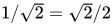


On the other hand, the following are not groups:
- The nonnegative integers under addition: There is an identity element, namely 0. However, the additive inverse of a nonnegative integer is not always a nonnegative integer, so the set of nonnegative integers does not have additive inverses. Hence, it is not a group.
- The nonzero integers under multiplication: There is an identity element: . However, not every integer has a multiplicative inverse, so this set does not have multiplicative inverses. Hence, it is not a group.
- The set of all rational numbers under multiplication: There is an identity element: . However, the element 0 does not have a multiplicative inverse, so the rational numbers do not form a group.
The most common avatar of (possibly) non-abelian groups is as automorphisms of a structure, which could be a set with some additional data. These include permutations of sets, linear automorphisms of vector spaces, self-homeomorphisms of topological spaces, Galois groups of field extensions, and diffeomorphisms of differential manifolds. In particular:
- Given a finite set, the permutations of that set form a group, where the group operation is composition, the identity element is the identity permutation, and the inverse of a permutation is its inverse as a function. For a finite set , this group is termed the symmetric group on , and is denoted by .
- Given a vector space ,the invertible linear transformations of that vector space form a group under composition, where the identity element is the identity map and the inverse of a given transformation is its inverse as a function. For a vector space , this group is denoted , and is termed the general linear group on .


On the other hand, the following do not form groups:
- Given a finite set , the set of all functions , under composition. That's because if a function from to is not bijective, it does not have an inverse function.
- Given a vector space , the set of all linear transformations , under composition. That's because many linear transformations, like the zero map, do not have inverses.


Other instances include the mapping class group, the ideal class group, the divisor class group, the fundamental group and so on.
List of particular groups
For detailed information on particular groups (i.e. groups fixed uniquely upto isomorphism) refer:
Viewpoints on the collection of groups
The collection of groups can be viewed in its totality as a category, as a variety, and in many other ways. For a list of articles on such viewpoints, refer:
Category:Views of the collection of groups
Properties over groups
Further information: group property
A property over groups, or a group property, is something that, for every group, is either true or false. For instance, the property of being abelian is a group property, because, given any group, it is either abelian or not abelian.
Group properties are very important tools in our attempts to understand the wide and vast array of groups. Typical group properties include being abelian, nilpotent, solvable, and so on.
A full listing of group properties is available at
Constructions
Homomorphism
Further information: Homomorphism of groups
A homomorphism of groups is a function from one group to another that preserves the group structure.
As per the textbook definition, a homomorphism of groups and is a map → such that for any in , .



is termed the source group and the image group.
As per the universal algebraic definition, a homomorphism of groups and is a map → such that satisfies:

- (for all in ) viz preserves the binary operation
- viz maps the identity element to the identity element


Both these definitions are equivalent. For full proof, refer: Equivalence of definitions of group homomorphism
Subgroup
Further information: Subgroup
A subgroup of the group is a subset of the group that inherits a group structure by restricting the operations.
As per the universal algebraic definition, a subset of a group is termed a subgroup if :
- Whenever belong to , so does
- Whenever belongs to , so does
- belongs to

There are two other equivalent definitions of subgroup:
- A subset of a group is termed a subgroup if it is nonempty and is closed under the left quotient of elements
- A subset of a group is termed a subgroup if it is nonempty and is closed under the right quotient of elements
For full proof, refer: Sufficiency of subgroup condition
A subgroup of a group can also be viewed as another group along with an injective homomorphism to the given group.
Quotient
Further information: Quotient group
A quotient group of a group is the image of the group under a surjective homomorphism.
Isomorphism
Further information: isomorphism of groups
An isomorphism of groups is a homomorphism from one group to another for which there exists an inverse homomorphisms. In symbols, an isomorphism → is a homomorphism such that there exists a map → with the property that is the identity on and is the identity on .


Two groups are said to be isomorphic if there exists an isomorphism between them. If two groups are isomorphic, then all their group-theoretic constructions are equivalent. In fact, we can use an isomorphism to map any group-theoretic construct of one to a group-theoretic construct of the other.
Automorphisms and endomorphisms
Further information: Endomorphism, Automorphism
An endomorphism of a group is a homomorphism from the group to itself. If the endomorphism has an inverse map which is also an endomorphism, it is termed an automorphism. Automorphisms can be viewed as symmetries of groups.
Variations on the notion of group
There are many variations to the notion of group, such as the notion of semigroup, monoid, magma, etc. A full list of variations is available here.
Studying all these objects at once
The collection of all objects of this type, together, can be viewed in the following nice ways
- Variety of groups: This term is used in universal algebra, where we view all groups as algebras of an equational variety, where the equational variety is defined as having the three operations subject to the three identities.
- Category of groups: This term is used in category theory, where we view all groups as objects of a category, and homomorphisms between groups as morphisms of the category
- First-order theory of groups: Here, we view each group as a model for the first-order theory of groups.
References
Textbook references
- Groups and representations by Jonathan Lazare Alperin and Rowen B. Bell, ISBN 0387945261, More info, Page 1-2
- Abstract Algebra by David S. Dummit and Richard M. Foote, 10-digit ISBN 0471433349, 13-digit ISBN 978-0471433347, More info, Page 16-17 (formal definition)
- Algebra by Serge Lang, ISBN 038795385X, More info, Page 3-4 (introduces groups as a particular kind of monoid)
- Topics in Algebra by I. N. Herstein, More info, Page 27 (formal definition)
- Algebra by Michael Artin, ISBN 0130047635, 13-digit ISBN 978-0130047632, More info, Page 42 (formal definition, based on components defined through pages 38-41)
- A Course in the Theory of Groups by Derek J. S. Robinson, ISBN 0387944613, More info, Page 1 (formal definition)
- An Introduction to Abstract Algebra by Derek J. S. Robinson, ISBN 3110175444, More info, Page 32 (formal definition)
- A First Course in Abstract Algebra (6th Edition) by John B. Fraleigh, ISBN 0201763907, More info, Page 52, Section 1.3.1 (formal definition)
- Algebra (Graduate Texts in Mathematics) by Thomas W. Hungerford, ISBN 0387905189, More info, Page 24, Definition 1.1 (formal definition)
- Contemporary Abstract Algeba by Joseph Gallian, ISBN 0618514716, More info, Page 41
External links
Mathjourneys links
- Group Theory: A First Journey is an article giving the basic definitions of group
- Group Theory: The Journey Continues (Part I) is an article building on the First Journey to develop the notions of group acting on a set and the ideas of coset space.