Characteristic of normal implies normal
This article describes a computation relating the result of the Composition operator (?) on two known subgroup properties (i.e., Characteristic subgroup (?) and Normal subgroup (?)), to another known subgroup property (i.e., Normal subgroup (?))
View a complete list of composition computations
Statement
Property-theoretic statement
Characteristic * Normal Normal

Here, denotes the composition operator.

Verbal statement
Every characteristic subgroup of a normal subgroup is normal.
Statement with symbols
Let be groups such that is characteristic in and is normal in . Then, is normal in .


Related facts
Basic ideas implicit in the definitions
- Restriction of automorphism to subgroup invariant under it and its inverse is automorphism: If is a subgroup and is an automorphism of such that both and send to within itself, then restricts to an automorphism of . This is the key idea used in arguing that an inner automorphism of the biggest group must restrict to an automorphism of the intermediate subgroup, rather than merely to a homomorphism from the intermediate subgroup to itself. Note that this idea is implicit in the equivalence between different formulations of the notion of normal subgroup.


Related facts in group theory
- Characteristicity is transitive: A characteristic subgroup of a characteristic subgroup is characteristic.
- Left transiter of normal is characteristic: Characteristicity is the weakest, or most general property, for which the above statement is true. This is made precise in the statement that characteristicity is the left transiter for normality.
- Automorph-permutable of normal implies conjugate-permutable: This statement has many corollaries; for instance, 2-subnormal implies conjugate-permutable
Analogues
- Derivation-invariant subring of ideal implies ideal: This is the analogous statement for Lie rings. Here, derivations play the role of automorphisms, Lie subrings play the role of subgroups, ideals play the role of normal subgroups, inner derivations play the role of inner automorphisms, and derivation-invariant subrings play the role of characteristic subgroups.
Applications
For a complete list of applications, refer:
Category:Applications of characteristic of normal implies normal
Definitions used
Characteristic subgroup
Further information: Characteristic subgroup
The definitions we use here are as follows:
- Hands-on definition: A subgroup of a group is termed a characteristic subgroup, if for any automorphism of , we have .
- Definition using function restriction expression: We can write characteristicity as the balanced subgroup property with respect to automorphisms:

Characteristic = Automorphism Automorphism

This is interpreted as: any automorphism from the whole group to itself, restricts to an automorphism from the subgroup to itself. Note that this is stronger than simply saying that it maps the subgroup to within itself -- we also demand that the restriction be an automorphism of the subgroup.
Normal subgroup
Further information: Normal subgroup
The definitions we use here are as follows:
- Hands-on definition: A subgroup of a group is termed normal, if for any , the inner automorphism defined by conjugation by , namely the map , gives a map from to itself. In other words, for any :


or more explicitly:

Implicit in this definition is the fact that is an automorphism. Further information: Group acts as automorphisms by conjugation
Note that it turns out that the above also implies that (This is because we have as well as ). This equivalence of ideas is crucial to the proof.


- Definition using function restriction expression: We can write normality as the invariance property with respect to inner automorphisms:
Normal = Inner automorphism Automorphism
In other words, any inner automorphism on the whole group restricts to an automorphism from the subgroup to itself. Note that this is stronger than saying that the inner automorphism simply sends the subgroup to itself -- we also demand that the restriction itself be an automorphism of the subgroup.
Facts used
- Restriction of automorphism to subgroup invariant under it and its inverse is automorphism
- Composition rule for function restriction: This is used for the proof using function restriction expressions.
Proof
This proof uses a tabular format for presentation. Provide feedback on tabular proof formats in a survey (opens in new window/tab) | Learn more about tabular proof formats|View all pages on facts with proofs in tabular format
Hands-on proof
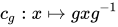
Given: Groups such that is characteristic in and is normal in . An element .
To Prove: The map , the map maps to (and in fact, yields an automorphism of ).
Proof:
| Step no. | Assertion/construction | Facts used | Given data used | Previous steps used | Explanation |
|---|---|---|---|---|---|
| 1 | for every and restricts to an automorphism of . Call this automorphism . | definition of normal subgroup Fact (1) |
is normal in is in . |
[SHOW MORE] | |
| 2 | sends to itself, and in fact restricts to an automorphism of . | definition of characteristic subgroup | is characteristic in | Step (1) | direct |
| 3 | sends to itself and restricts to an automorphism of . | Steps (1), (2) | [SHOW MORE] |


Using function restriction expressions
In terms of the function restriction formalism:
- The following is a function restriction expression for the subgroup property of normality:
Inner automorphism Automorphism
In other words, every inner automorphism of the whole group restricts to an automorphism of the subgroup.
- The following is a function restriction expression for the subgroup property of characteristicity:
Automorphism Automorphism
In other words, every automorphism of the whole group restricts to an automorphism of the subgroup.
We now use the composition rule for function restriction to observe that the composition of characteristic and normal implies the property:
Inner automorphism Automorphism
Which is again the subgroup property of normality.
References
Textbook references
- Abstract Algebra by David S. Dummit and Richard M. Foote, 10-digit ISBN 0471433349, 13-digit ISBN 978-0471433347, Page 135, Section 4.4 (Automorphisms), Point (3) after definition of characteristic subgroup, More info. Also, Page 137, Exercise 8(a).
- A Course in the Theory of Groups by Derek J. S. Robinson, ISBN 0387944613, Page 28, Section 1.5 (Characteristic and Fully invariant subgroups), 1.5.6(iii), More info
- Topics in Algebra by I. N. Herstein, Page 70, Problem 9, More info
- Nilpotent groups and their automorphisms by Evgenii I. Khukhro, ISBN 3110136724, Page 4, Section 1.1, (passing mention)More info