Tour:Hard nuts four (beginners)
This page is a Hard nuts page, part of the Groupprops guided tour for beginners (Jump to beginning of tour)
PREVIOUS: Mind's eye test four (beginners)| UP: Introduction four | NEXT: Interdisciplinary problems four (beginners)
NEXT SECTION Hard nuts: Hard nuts five
General instructions for the tour | Pedagogical notes for the tour | Pedagogical notes for this part
This includes problems that are either too hard or too unimportant to be part of the mind's eye test. Learners are not required to tackle these problems, and can skip ahead without loss of continuity. These problems are ideal for people revisiting the tour or seeking a challenge.
Additive cyclic groups
- NEEDS LOT OF THOUGHT: Suppose are subgroups of . Prove (by reducing the problem to one involving lcm and gcd, and then using the definitions of lcm and gcd in terms of prime factorization) that:
- NEEDS SOME THOUGHT: Prove the results above, replacing by any cyclic group.
- NEEDS SOME THOUGHT: Let be a finite subset of . Prove that the subgroup generated by is cyclic. (A group with the property that every finite subset generates a cyclic group is termed a locally cyclic group).
- NEEDS SOME THOUGHT: Suppose is an Abelian group and , such that there exist , such that . Prove that there exists a such that . Generalize the result replacing 2,3 by any two integers, and replacing 6 by the least common multiple of these integers.
- Using the previous problem, prove that if an arithmetic progression of integers contains a perfect square and a perfect cube, then it contains a perfect sixth power. (Hint: First use the previous problem to solve the case where the common difference is relatively prime to the terms of the progression)
- Prove that the multiplicative group of all roots of unity in is locally cyclic: the subgroup generated by any finite subset is cyclic.
- NEEDS LOT OF THOUGHT: Prove that any additive subgroup of is either dense or infinite cyclic, generated by the positive element of smallest magnitude in it. (Dense here means that it intersects every open interval, and cyclic means that it is additively generated by an element). This is a generalization of the fact that any subgroup of is infinite cyclic.
- NEEDS LOT OF THOUGHT: Prove that if a finite group of order has exactly one subgroup of order for each , then the finite group is cyclic. (Hint: Use the general result obtained in the Mind's eye test, about any finite group equal to the union of the set of generators for its cyclic subgroups)


Multiplicative groups
For these exercises, use the fact that if is prime, the multiplicative group mod is a cyclic group. Direct application of Fermat's little theorem, and the concept of order of an element, are useful.

- An element mod (not zero mod ) is termed a quadratic residue mod if there exists such that . Otherwise is termed a quadratic nonresidue. Prove that for an odd prime , there are exactly quadratic residues and quadratic nonresidues. Further, show that is a quadratic residue mod if and only , and is a quadratic nonresiude if and only if .
- Prove that the quadratic residues form a subgroup of index two, and the quadratic nonresidues form the other coset.
- A primitive element mod is an element that generates the multiplicative group mod . Prove that there are exactly primitive elements.
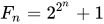
- The Fermat number is defined as: . Prove that if is a prime divisor of , then is a multiple of .
- An element mod (not zero mod ) is termed a cubic residue mod if there exists such that . Prove that the cubic residues form a multiplicative subgroup of the multiplicative group mod . Further prove that if , then this subgroup has index three, and otherwise, the subgroup is the whole group.
- Prove that if is a prime divisor of for a prime and an integer , then either or .










This page is a Hard nuts page, part of the Groupprops guided tour for beginners (Jump to beginning of tour)
PREVIOUS: Mind's eye test four (beginners)| UP: Introduction four | NEXT: Interdisciplinary problems four (beginners)
NEXT SECTION Hard nuts: Hard nuts five
General instructions for the tour | Pedagogical notes for the tour | Pedagogical notes for this part