Periodicity is extension-closed
This article gives the statement, and possibly proof, of a group property (i.e., periodic group) satisfying a group metaproperty (i.e., extension-closed group property)
View all group metaproperty satisfactions | View all group metaproperty dissatisfactions |Get help on looking up metaproperty (dis)satisfactions for group properties
Get more facts about periodic group |Get facts that use property satisfaction of periodic group | Get facts that use property satisfaction of periodic group|Get more facts about extension-closed group property
Statement
Suppose is a group and is a normal subgroup of such that both and the quotient group are periodic groups. Then, is also a periodic group.


Further, if is a set of primes such that both and are -groups -- all prime factors of orders of elements in these groups are in -- then is also a -group.

Related facts
Proof
We prove the second version. Note that taking to be the set of all primes will give the first version.
Given: A group . A normal subgroup with quotient group . A prime set such that both and are -groups: all elements of and all elements of have finite orders with all prime divisors of the order of every element in .
To prove: Every element of has finite order and every prime divisor of the order of every element is in .
Proof: We pick an arbitrary element . We let be the quotient map.

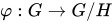
| Step no. | Assertion/construction | Facts used | Given data used | Previous steps used | Explanation |
|---|---|---|---|---|---|
| 1 | has order equal to some -number as an element of . | is a -group. | |||
| 2 | where is the -number chosen in Step (1). | Step (1) | |||
| 3 | Let from Step (2). Then, has order equal to some -number as an element of . | is a -group | Step (2) | ||
| 4 | is the identity element of . Thus, the order of in is finite and divides the -number , hence it must also be a -number. | Step (3) |


