Characteristic of normal implies normal: Difference between revisions
| Line 49: | Line 49: | ||
In terms of the function restriction formalism: | In terms of the function restriction formalism: | ||
* The following is a [[restriction | * The following is a [[function restriction expression]] for the subgroup property of normality: | ||
Inner automorphism <math>\to</math> Automorphism | Inner automorphism <math>\to</math> Automorphism | ||
* The following is a [[restriction | In other words, every inner automorphism of the whole group restricts to an automorphism of the subgroup. | ||
* The following is a [[function restriction expression]] for the subgroup property of characteristicity: | |||
Automorphism <math>\to</math> Automorphism | Automorphism <math>\to</math> Automorphism | ||
In other words, every automorphism of the whole group restricts to an automorphism of the subgroup. | |||
We now use the [[composition rule for function restriction]] to observe that the composition of characteristic and normal implies the property: | We now use the [[composition rule for function restriction]] to observe that the composition of characteristic and normal implies the property: | ||
Revision as of 17:47, 4 April 2008
This article describes a computation relating the result of the Composition operator (?) on two known subgroup properties , to another known subgroup property
View a complete list of composition computations
For applications of this term/fact/idea, refer: Category:Applications of characteristic of normal implies normal
Statement
Property-theoretic statement
Characteristic * Normal Normal

Here, denotes the composition operator.

Verbal statement
Every characteristic subgroup of a normal subgroup is normal.
Symbolic statement
Let such that is characteristic in and is normal in , then is normal in .


Related facts
- Characteristicity is transitive: A characteristic subgroup of a characteristic subgroup is characteristic.
- Left transiter of normal is characteristic: Characteristicity is the weakest, or most general property, for which the above statement is true. This is made precise in the statement that characteristicity is the left transiter for normality.
- Automorph-permutable of normal implies conjugate-permutable: This statement has many corollaries; for instance, 2-subnormal implies conjugate-permutable
Applications
For a complete list of applications, refer:
Category:Applications of characteristic of normal implies normal
Proof
Hands-on proof
Given: groups such that is characteristic in and is normal in .
To Prove: For any , the map takes to within itself.

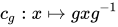
Proof: First, notice that since , for every . Thus, restricts to a function from to . Since this function arises by restricting an automorphism of , it is an endomorphism of .


Further, since and are both the identity map, and is invariant under both, the restriction of to is actually an invertible endomorphism, viz an automorphism. Call this automorphism .


Since is characteristic in , takes to within itself. But since is the restriction of to in the first place, we conclude that in fact takes to itself.
Using the function restriction formalism
In terms of the function restriction formalism:
- The following is a function restriction expression for the subgroup property of normality:
Inner automorphism Automorphism

In other words, every inner automorphism of the whole group restricts to an automorphism of the subgroup.
- The following is a function restriction expression for the subgroup property of characteristicity:
Automorphism Automorphism
In other words, every automorphism of the whole group restricts to an automorphism of the subgroup.
We now use the composition rule for function restriction to observe that the composition of characteristic and normal implies the property:
Inner automorphism Automorphism
Which is again the subgroup property of normality.
References
Textbook references
- Abstract Algebra by David S. Dummit and Richard M. Foote, 10-digit ISBN 0471433349, 13-digit ISBN 978-0471433347More info, Page 135, Page 137 (Problem 8(a))
- A Course in the Theory of Groups by Derek J. S. Robinson, ISBN 0387944613More info, Page 28 (Characteristic and Fully invariant subgroups, 1.5.6(iii))
- Topics in Algebra by I. N. HersteinMore info, Page 70 (Problem 9)