Endomorphism sends more than three-fourths of elements to squares implies abelian
This article is about a result whose hypothesis or conclusion has to do with the fraction of group elements or tuples of group elements satisfying a particular condition.The fraction involved in this case is 3/4
View other such statements
Statement
Suppose is a finite group and is an endomorphism of . Suppose the subset of given by:


has size more than of the order of . Then, is an abelian group (in particular, a finite abelian group) and sends every element of to its square.


Related facts
- Automorphism sends more than three-fourths of elements to inverses implies abelian
- Inverse map is automorphism iff abelian
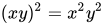
- Square map is endomorphism iff abelian
- Cube map is automorphism implies abelian
Facts used
- The set of elements that commute with any fixed element of the group, is a subgroup: the so-called centralizer of the element.
- The set of elements that commute with every element of the group, is a subgroup: the so-called center of the group
- Subgroup of size more than half is whole group
- Abelian implies universal power map is endomorphism
- The image of a generating set under a homomorphism completely determines the homomorphism.
Proof
This proof uses a tabular format for presentation. Provide feedback on tabular proof formats in a survey (opens in new window/tab) | Learn more about tabular proof formats|View all pages on facts with proofs in tabular format
Proof details
Given: A finite group , an endomorphism of . is the subset of comprising those for which . We are given that .


To prove: is abelian and , i.e., for all .


Proof: We initially focus on a single element and try to show that its centralizer is the whole of . We then shift focus to as a set, show that it is contained in the center, and since the center is a subgroup, it is forced to be all of .

| Step no. | Assertion/construction | Facts used | Given data used | Previous steps used | Explanation | Commentary |
|---|---|---|---|---|---|---|
| 1 | Suppose are such that are all in . Then | -- | Definition of as the set of elements mapped to their squares, is an endomorphism | [SHOW MORE] | Convert local property of elements going to squares to local property of pairs commuting. | |
| 2 | For any , define . We have , where is the centralizer of in . | Step (1) | [SHOW MORE] | Toward establishing a large centralizer for fixed but arbitrary element of -- use local property of elements going to squares. | ||
| 3 | For any , the intersection has size greater than | [SHOW MORE] | Toward establishing a large centralizer for fixed but arbitrary element of -- use size constraints and combinatorial formula. | |||
| 4 | For any , the subgroup is equal to the whole group | Facts (1), (3) | Steps (2), (3) | [SHOW MORE] | Complete establishing that a fixed but arbitrary element of has centralizer the whole group -- use that big enough subgroups must contain everything. | |
| 5 | is contained in the center of | Step (4) | [SHOW MORE] | Shift focus to as a set. | ||
| 6 | equals its own center, hence is abelian | Facts (2), (3) | Step (5) | [SHOW MORE] | Clinch -- use that big enough subgroups must contain everything. | |
| 7 | is a generating set for . | Fact (3) | -- | [SHOW MORE] | ||
| 8 | , i.e., for all . | Facts (4), (5) | -- | Steps (6), (7) | [SHOW MORE] |





Steps (6) and (8) clinch the proof.