Classification of groups of prime-cube order: Difference between revisions
(g) |
|||
| Line 106: | Line 106: | ||
'''Case B''': <math>a</math> has order <math>p^2</math>, <math>b</math> has order <math>p</math> | '''Case B''': <math>a</math> has order <math>p^2</math>, <math>b</math> has order <math>p</math> | ||
In this case, we first note that <math>a^p \in Z = \langle z \rangle</math>. Since <math>a^p</math is a non-identity element, there exists nonzero <math>r</math> (taken mod <math>p</math>) such that <math>a^p = z^r</math>. Consider the element <math>c = b^r</math> Then, by Fact (8), and the observation that <math>P</math> has class two (Step (1) in the above table), we obtain: | In this case, we first note that <math>a^p \in Z = \langle z \rangle</math>. Since <math>a^p</math> is a non-identity element, there exists nonzero <math>r</math> (taken mod <math>p</math>) such that <math>a^p = z^r</math>. Consider the element <math>c = b^r</math> Then, by Fact (8), and the observation that <math>P</math> has class two (Step (1) in the above table), we obtain: | ||
<math>\! [a,c] = [a,b^r] = [a,b]^r = z^r = a^p</math> | <math>\! [a,c] = [a,b^r] = [a,b]^r = z^r = a^p</math> | ||
Revision as of 00:44, 26 April 2011
Statement
Let be a prime number. Then there are, up to isomorphism, five groups of order . These include three abelian groups and two non-abelian groups. The nature of the two non-abelian groups is somewhat different for the case .


For more information on side-by-side comparison of the groups for odd primes, see groups of prime-cube order. For information for the prime 2, see groups of order 8
The three abelian groups
The three abelian groups correspond to the three partitions of 3:
| Partition of 3 | Corresponding abelian group | GAP ID among groups of order |
|---|---|---|
| 3 | cyclic group of prime-cube order, denoted or , or | 1 |
| 2 + 1 | direct product of cyclic group of prime-square order and cyclic group of prime order, denoted or | 2 |
| 1 + 1 + 1 | elementary abelian group of prime-cube order, denoted , or , or | 5 |


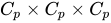

The two non-abelian groups
For the case , these are dihedral group:D8 (GAP ID: (8,3)) and quaternion group (GAP ID: (8,4)).
For the case of odd , these are prime-cube order group:U(3,p) (GAP ID: (,3)) and semidirect product of cyclic group of prime-square order and cyclic group of prime order (GAP ID: (,4)).
Facts used
- Prime power order implies not centerless
- Center is normal
- Cyclic over central implies abelian
- Lagrange's theorem
- Equivalence of definitions of group of prime order: This basically states that any group of prime order must be cyclic.
- Classification of groups of prime-square order
- Structure theorem for finitely generated abelian groups
- Class two implies commutator map is endomorphism
- Formula for powers of product in group of class two
Proof
First part of proof: crude descriptions of center and quotient by center
Given: A prime number , a group of order .

To prove: Either is abelian, or we have: is a cyclic group of order and is an elementary abelian group of order


Proof: Let be the center of .

| Step no. | Assertion/construction | Facts used | Given data used | Previous steps used | Explanation |
|---|---|---|---|---|---|
| 1 | is nontrivial | Fact (1) | has order , specifically, a power of a prime | Fact+Given direct | |
| 2 | The order of cannot be | Facts (2), (3), (4), (5) | has order | [SHOW MORE] | |
| 3 | The order of is either or | Fact (4) | has order | Steps (1), (2) | [SHOW MORE] |
| 4 | If has order , then is cyclic of order and the quotient is elementary abelian of order | Facts (3), (4), (5), (6) | has order . | [SHOW MORE] | |
| 5 | If has order , is abelian. | has order . | [SHOW MORE] | ||
| 6 | We get the desired result. | Steps (3), (4), (5) | Step-combination. |


Second part of proof: classifying the abelian groups
This classification follows from fact (7): the abelian groups of order correspond to partitions of 3, as indicated in the original statement of the classification.
Third part of proof: classifying the non-abelian groups
Given: A non-abelian group of order . Let be the center of .
Previous steps: is cyclic of order , and is elementary abelian of order .
We first make some additional observations.
| Step no. | Assertion/construction | Facts used | Given data used | Previous steps used | Explanation |
|---|---|---|---|---|---|
| 1 | The derived subgroup (commutator subgroup) equals , so has class two. | is non-abelian of order . | is abelian, has order . | [SHOW MORE] | |
| 2 | We can find elements such that the images of in are non-identity elements of that generate it. | is elementary abelian of order | [SHOW MORE] | ||
| 3 | together generate . | ||||
| 4 | and do not commute. | Steps (2), (3) | [SHOW MORE] | ||
| 5 | Let . Then, is a non-identity element of and . | Steps (1), (4) | [SHOW MORE] | ||
| 6 | The elements both have order either or . Also, the elements and are both in . | [SHOW MORE] |


![{\displaystyle z=[a,b]}](https://wikimedia.org/api/rest_v1/media/math/render/svg/5566995bf8afcb63d83e13ab13e7d753d0db0be9)


![{\displaystyle [a,b]}](https://wikimedia.org/api/rest_v1/media/math/render/svg/9c4b788fc5c637e26ee98b45f89a5c08c85f7935)


We now make cases based on the orders of and . Note that these cases may turn out to yield isomorphic groups, because the cases are made based on and , and there is some freedom in selecting these.
Case A: and both have order .
In this case, the relations so far give the presentation:
![{\displaystyle \langle a,b,z\mid a^{p}=b^{p}=z^{p}=e,az=za,bz=zb,[a,b]=z\rangle }](https://wikimedia.org/api/rest_v1/media/math/render/svg/2ac6dd00965102f89a1ca60f482f8b617be79529)
These relations already restrict us to order at most , because we can use the commutation relations to express every element in the form , where are integers mod . To show that there is no further reduction, we note that there is a group of order satisfying all these relations, namely prime-cube order group:U(3,p). This is the multiplicative group of unipotent upper-triangular matrices with entries from the field of elements.


Thus, Case A gives a unique isomorphism class of groups. Note that the analysis so far works both for and for odd primes. The nature of the group obtained, though, is different for , where we get dihedral group:D8 which has exponent . For odd primes, we get a group of prime exponent.
Case B: has order , has order
In this case, we first note that . Since is a non-identity element, there exists nonzero (taken mod ) such that . Consider the element Then, by Fact (8), and the observation that has class two (Step (1) in the above table), we obtain:


![{\displaystyle \![a,c]=[a,b^{r}]=[a,b]^{r}=z^{r}=a^{p}}](https://wikimedia.org/api/rest_v1/media/math/render/svg/0de9937cf2215e28f2f9a39da68aaf076a500617)
Consider the presentation:
![{\displaystyle \langle a,c\mid a^{p^{2}}=c^{p}=e,[a,c]=a^{p}\rangle }](https://wikimedia.org/api/rest_v1/media/math/render/svg/a2f34dbaac9833749b98047cf8e6a85f5605971a)
We see that all these relations are forced by the above, and further, that this presentation defines a group of order , namely semidirect product of cyclic group of prime-square order and cyclic group of prime order.
Thus, there is a unique isomorphism class in Case B. Note that the analysis so far works both for and for odd primes. The nature of the group, though, is different for , we get dihedral group:D8, which is the same isomorphism class as Case A.
Case B2: has order , has order .
Interchange the roles of and replace by and we are back in Case B.

Case C: and both have order .
By Fact (9), we can show that for odd prime, it is possible to make a substitution and get into Case B. PLACEHOLDER FOR INFORMATION TO BE FILLED IN: [SHOW MORE]
For , working out the presentation yields quaternion group.
Here is a summary of the cases:
| Case letter | What it means | Isomorphism class of group for | Isomorphism class of group for odd prime |
|---|---|---|---|
| A | Both have order | dihedral group:D8 | prime-cube order group:U(3,p) |
| B, B2 | One of the elements has order , the other has order | dihedral group:D8 | semidirect product of cyclic group of prime-square order and cyclic group of prime order |
| C | Both elements have order | quaternion group | semidirect product of cyclic group of prime-square order and cyclic group of prime order |
Finally, we note that:
- Dihedral group:D8 and quaternion group are non-isomorphic: The latter has no non-central element of order two, for instance.
- prime-cube order group:U(3,p) and semidirect product of cyclic group of prime-square order and cyclic group of prime order are non-isomorphic: The former has exponent , the latter has exponent .