Understanding the quotient map: Difference between revisions
(New page: {{survey article|group}} The notions of normal subgroup, quotient map and quotient group are somewhat tricky to understand the first time. These notions are also extremely crucial to the ...) |
No edit summary |
||
| Line 72: | Line 72: | ||
Further, the two associations are inverses of each other, in the following weak sense. Suppose <math>\varphi:G \to H</math> is a surjective homomorphism of groups, and <math>\sim</math> is the equivalence relation that this generates on <math>G</math>. This equivalence relation is a congruence. Consider the quotient map <math>\varphi': G \to G/\sim</math>. Then, there is a natural isomorphism <math>\sigma:G/\sim \to H</math> such that <math>\sigma \circ \varphi' = \varphi</math>. | Further, the two associations are inverses of each other, in the following weak sense. Suppose <math>\varphi:G \to H</math> is a surjective homomorphism of groups, and <math>\sim</math> is the equivalence relation that this generates on <math>G</math>. This equivalence relation is a congruence. Consider the quotient map <math>\varphi': G \to G/\sim</math>. Then, there is a natural isomorphism <math>\sigma:G/\sim \to H</math> such that <math>\sigma \circ \varphi' = \varphi</math>. | ||
==What makes groups different from sets== | |||
===A quick preview=== | |||
On a set, we can have practically ''any'' kind of equivalence relation. The equivalence classes may have different sizes, and knowing one equivalence class may not determine what the other equivalence classes look like. | |||
A congruence on a group, however, is extremely controlled, in three important ways: | |||
* All the equivalence classes have the same size. {{further|[[Left cosets are in bijection via left multiplication]]}} | |||
* The equivalence class containing the identity element is a [[normal subgroup]], and every normal subgroup can be realized as the equivalence class of the identity element under a congruence. {{further|[[Normal subgroup equals kernel of homomorphism]]}} | |||
* The equivalence class of the identity element determines the entire congruence. In particular, it determines the quotient map. Thus, given any normal subgroup, we can talk of the quotient map corresponding to that normal subgroup. This allows us to reformulate the correspondence between surjective homomorphisms and congruences, as a correspondence between surjective homomorphisms and normal subgroups. That's how the [[first isomorphism theorem]] is usually stated. | |||
This is in sharp contrast with sets, and somehow shows that the structure of groups is more uniform and better controlled by what happens at some places. | |||
===Viewing this in terms of the variety of groups=== | |||
One approach to studying algebraic structures is universal algebra, where we look at sets with arbitrary collections of operations satisfying identities. In this language, the [[variety of groups]] is given by three operations (multiplication, inverse and the identity element) satisfying the identities of associativity, identity element, and inverses. Here, an individual group is treated as an ''algebra'' in the variety of groups. | |||
We can define a [[congruence on an algebra]] as an equivalence relation that is respected by all the algebra operations. This gives rise to the usual notion of congruence on a group: an equivalence relation on the group that is preserved by the multiplication and the inverse map. Then, it is true for a general variety of algebras that: | |||
* Any surjective homomorphism from an algebra gives rise to a congruence on that algebra | |||
* Any congruence on an algebra gives rise to a surjective homomorphism from that algebra, namely, the quotient map | |||
* These two maps are inverses of each other in the weak sense (as described for groups and sets) | |||
What makes the variety of groups ''different'' is that the congruences are particularly nice. In the language of universal algebra, this says: | |||
# [[Variety of groups is ideal-determined]]: A congruence on a group is completely determined by the equivalence class of the identity element, which is a normal subgroup, and any normal subgroup comes from a congruence. | |||
# [[Variety of groups is congruence-uniform]]: The equivalence classes under any congruence on a group are equal in size. | |||
There are other interesting facts about the quotient map for groups that makes them better-behaved than other algebraic structures, such as the fact that [[ideals are subalgebras in the variety of groups]] (every normal subgroup ''is'' a subgroup) and [[characteristic subalgebras are ideals in the variety of groups]] ([[characteristic implies normal|characteristic subgroups are normal]]). | |||
==Examples in Abelian groups== | |||
===Modular arithmetic=== | |||
===Vector spaces=== | |||
==Examples in non-Abelian groups== | |||
Revision as of 15:47, 27 June 2008
This is a survey article related to:group
View other survey articles about group
The notions of normal subgroup, quotient map and quotient group are somewhat tricky to understand the first time. These notions are also extremely crucial to the structure theory of groups. In this survey article, we study the differing approaches we can take to studying and understanding the quotient map. We begin with a few examples.
Quotient maps for sets
In arithmetic, we think of a quotient as a division of one number by another. While this description is somewhat relevant, it is not the most appropriate for quotient maps of groups. A better way is to first understand quotient maps of sets.
A quotient map, and surjective homomorphism, of sets
Suppose and are two sets, and is a surjective function (or set map). In other words, for every , the set is nonempty. Then, we can associate, to each , the set .




Observe that:
- The sets form a partition of into disjoint, nonempty subsets.
- Two elements are in the same part if and only if
- So, the sets are the equivalence classes in under the equivalence relation


Now, suppose that instead of a map , we started with an equivalence relation on . Then, we could construct a set as the set of equivalence classes under , and define a map as sending each to its equivalence class. This is termed the quotient map for the equivalence relation .


Thus, we have:
- A way of using a surjective function to construct an equivalence relation (namely, the equivalence relation of having the same image)
- A way of using an equivalence relation to generate a surjective function (namely, the quotient map of that equivalence relation)
These two associations are inverses of each other in a weak sense. Namely, if we start with a function , obtain the equivalence relation, and then consider the quotient map , then we can construct a natural bijection such that . The bijection simply sends an equivalence class of elements in to the image of any of those elements, in .
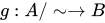

Conversely, if we start with an equivalence relation , construct the quotient map, and take the equivalence relation arising from that quotient map, we recover the same equivalence relation .
Here's an example. Suppose , and is given by:
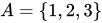


Then the equivalence relation generated has equivalence classes and . The quotient is the set:


with the map being:


and the natural bijection is given by:


When we impose the group structure
Quotient maps and congruences
We'd like to say something analogous to what was said for sets, but respecting the group structure. In other words, we want to relate surjective homomorphisms of groups, with quotient maps from certain equivalence relations.
One direction is easily done. Given any surjective homomorphism , we obtain an equivalence relation on . However, not every equivalence relation on can arise from a surjective homomorphism. The equivalence relation has some special properties. Let's look at this more closely.


The homomorphism condition tells us that if , then . In particular, it tells us that the image of depends only on the images of and . Thus, we have:


This imposes the following condition on the equivalence relation:

Similarly, we obtain that:

An equivalence relation satisfying the above conditions is termed a congruence on a group. We now see that, starting with any congruence on a group, we can take the corresponding quotient map, and give a group structure to the quotient, so that the map is a surjective homomorphism. Namely, given two equivalence classes, we multiply their representatives, and take the equivalence class of the product.
So, we have two associations:
- A surjective homomorphism gives rise to a congruence, namely, the equivalence relation of having the same image.
- A congruence gives rise to a surjective homomorphism, namely, its quotient map.
Further, the two associations are inverses of each other, in the following weak sense. Suppose is a surjective homomorphism of groups, and is the equivalence relation that this generates on . This equivalence relation is a congruence. Consider the quotient map . Then, there is a natural isomorphism such that .


What makes groups different from sets
A quick preview
On a set, we can have practically any kind of equivalence relation. The equivalence classes may have different sizes, and knowing one equivalence class may not determine what the other equivalence classes look like.
A congruence on a group, however, is extremely controlled, in three important ways:
- All the equivalence classes have the same size. Further information: Left cosets are in bijection via left multiplication
- The equivalence class containing the identity element is a normal subgroup, and every normal subgroup can be realized as the equivalence class of the identity element under a congruence. Further information: Normal subgroup equals kernel of homomorphism
- The equivalence class of the identity element determines the entire congruence. In particular, it determines the quotient map. Thus, given any normal subgroup, we can talk of the quotient map corresponding to that normal subgroup. This allows us to reformulate the correspondence between surjective homomorphisms and congruences, as a correspondence between surjective homomorphisms and normal subgroups. That's how the first isomorphism theorem is usually stated.
This is in sharp contrast with sets, and somehow shows that the structure of groups is more uniform and better controlled by what happens at some places.
Viewing this in terms of the variety of groups
One approach to studying algebraic structures is universal algebra, where we look at sets with arbitrary collections of operations satisfying identities. In this language, the variety of groups is given by three operations (multiplication, inverse and the identity element) satisfying the identities of associativity, identity element, and inverses. Here, an individual group is treated as an algebra in the variety of groups.
We can define a congruence on an algebra as an equivalence relation that is respected by all the algebra operations. This gives rise to the usual notion of congruence on a group: an equivalence relation on the group that is preserved by the multiplication and the inverse map. Then, it is true for a general variety of algebras that:
- Any surjective homomorphism from an algebra gives rise to a congruence on that algebra
- Any congruence on an algebra gives rise to a surjective homomorphism from that algebra, namely, the quotient map
- These two maps are inverses of each other in the weak sense (as described for groups and sets)
What makes the variety of groups different is that the congruences are particularly nice. In the language of universal algebra, this says:
- Variety of groups is ideal-determined: A congruence on a group is completely determined by the equivalence class of the identity element, which is a normal subgroup, and any normal subgroup comes from a congruence.
- Variety of groups is congruence-uniform: The equivalence classes under any congruence on a group are equal in size.
There are other interesting facts about the quotient map for groups that makes them better-behaved than other algebraic structures, such as the fact that ideals are subalgebras in the variety of groups (every normal subgroup is a subgroup) and characteristic subalgebras are ideals in the variety of groups (characteristic subgroups are normal).